High Plains Gardening
The gardening website of the Texas High Plains Region




Main blooms primarily during the months of July (last half), August and September, sometimes into the first part of October.
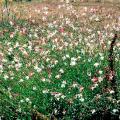
This is an improved variety to our native gaura, it is known to be short lived for 4 – 5 years, but is worth replacing periodically for its spectacular fireworks display. Placed as a focal point, G. lindheimeri ‘Whirling Butterflies” was the plant most commented on in my front garden. Native more to eastern Texas and Louisiana, a terrific plant for city or country in a medium water-use location. Any plant with long wispy stems that flows with the wind is an asset to your border. Other cultivars to use are ‘Siskiyou Pink’ and ‘Pink Cloud’, two pink varieties.
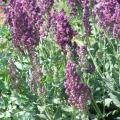
Unlike, S. nemorosa ‘May Night’, I don’t mind deadheading this salvia, perhaps because of its plum color it does not require as persistent deadheading. Notice the gray-green leaves of ‘Plumosa’, versus the green leaves of ‘May Night’. The stems tend to flop, but the flower stalks continue to grow and flower upright -- very strange.
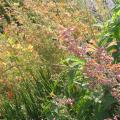
Agastaches are some of the Southwest's showiest natives and one of our native perennials where must breeding and hybridization is being done. Native to slightly higher elevations that 3600 ft., it requires either afternoon shade or medium water-use. It has not been reliable in coming back for me, but it has for others. Well drained soil is a must. Nonetheless, it is easy to be seduced by its masses of blooms and alluring fragrances. Hummingbirds certainly are entranced.
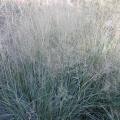
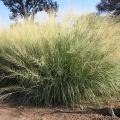
Alkali sacaton is a perennial warm season bunch grass native to the Southwest. In late summer to fall, airy triangular seed heads wave above the silver green grass blades. Grows in alkali soils, many say in locations where there is moisture nearby, prefering heavy clay soils. It is quite drought tolerant once established, and long lived. It will, of course, grow bigger or smaller depending on water resources.
Rose of Sharon, or Althea, is another reliable old-fashioned garden plant well suited for the Texas Panhandle. My favorite cultivar is Diana because of the brilliant, pure white 4-5” flowers and somewhat glossy green leaves. Diana is also one of the smaller varieties up to about 6 - 8 feet, while others can reach 10’ tall. Similar to most altheas, 'Diana' is a prolific bloomer.
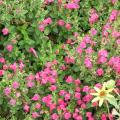
A Plant Select Plant for 2004, Pink Texas Skullcap has often been listed as a Zone 7 plant, but it is reliably cold hardy in Zone 6 and in protected Zone 5b sights. I’ve grown it in my xeristrip since 2000. Long blooming with no maintenance ever performed. These low growing, mounding skullcaps are excellent for Panhandle xeristrips and rock gardens. Native varieties are S. drummondii, and S. resinosa. The hybrid cultivar, S. x ‘Violet Cloud’, introduced by High Country Gardens, is an excellent violet skullcap as well as the natives.
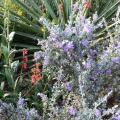
Big Bend silverleaf is the most cold hardy of the Leucophyllums and has wintered over in Amarillo, Zone 7, for 5 years so far. Possibly cold hardy to Zone 6. It is hard to beat a more attractive summer blooming shrub for small xeric spaces. After summer rainfalls, Big Bend silverleaf, native to the Big Bend National Park area, becomes covered in silver blue flowers that twinkle like jewels among its silvery gray leaves. Hard to find, it's worth searching for.
Giant sacaton is one of the largest bunch grasses native to the Southwest, like alkali sacaton on steroids. Seems to thrive in poor soils with no supplemental irrigation. It will grow even bigger with added moisture. Thick textured grass blades, it will rival pampas grass for size and beauty, although it plumes are near as showy, giant sacaton has a flowing fountain appearance. A warm season grass, it is cold hardy and thrives in sun and heat.