High Plains Gardening
The gardening website of the Texas High Plains Region




Plants that will live in areas that experience 90-120 heat days (AHS Heat Zone 8) each year where temperatures exceed 86 degrees F. Except for a few limited areas in the Texas Panhandle, our AHS Heat Zone is 8. Plants rated lower than AHS Heat Zone 8 may not survive the summer's heat.
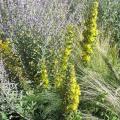
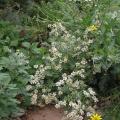
This variety purchased from Sunshine Nursery in Clinton, Oklahoma is drought tolerant, I've planted it in a low water-use bed. The flowers are so dense and golden, it looks like a golden torch. Sometimes seen as Solidago speciosa rigidiuscula, 'Wichita Mountains'
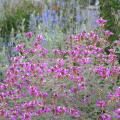
Black dalea, an autumn blooming southwest native shrub, should be used more in the home xeric landscape. Growing only to about 3 feet, black dalea spreads out with thin, wiry branches and small, green, compound leaves. The shrub becomes completely covered with tiny purple flowers as to be enshrouded in a purple cloud.
Many references are unsure of its cold hardiness to zero, and it had thrived nicely in my city garden in Amarillo. However, it does not seem to be reliably cold hardy. It's a beautiful shrub that provides stunning late fall color that is worth replanting.
You can't have just one. As soon as you plant one, you'll have a drift, then a sweep, then a field if you have the space. But I still don't consider the prairie coneflower to be invasive, merely pleasant. Next to the Indian Blanket, the Mexican Hat shouts Southwest prairies. And its a tough hombre. If your stand becomes too dense or too much, just weed some out. They're adaptable to most native soils and will thrive on available or once a month supplementation. Coneflowers bloom yellow, reddish or brown late spring into fall and make an attractive display when mixed.
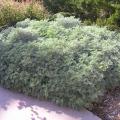
Low water-use non-native hybrid shrub (Artemisia arborescens x Artemisia absinthium) from Europe and Asia. Vigorous grower, do not overwater. Coldy hardy to Zone 6. Ever-silver with elegant finely cut leaves. 'Powis Castle' is named for Powis Castle in Wales. Rarely flowers.
For more information and a list a gray and silver leaved plants, read Fifty Shades of Gray, my most viewed page.
Maypop, or passion vine, is a perennial vine native to eastern and southern areas of the U.S. In the South, maypop grows into a woody vine, but in northern areas like the Texas Panhandle, it will die back to the ground. Lobed, dark green leaves, beautiful, unique flowers emerge in the summer to fall, producing edible fruit. Maypop will sucker, especially when ample watering is present. Passion vine, the most cold hardy of the genus, should be cold hardy to Zone 6.
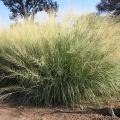
Giant sacaton is one of the largest bunch grasses native to the Southwest, like alkali sacaton on steroids. Seems to thrive in poor soils with no supplemental irrigation. It will grow even bigger with added moisture. Thick textured grass blades, it will rival pampas grass for size and beauty, although it plumes are near as showy, giant sacaton has a flowing fountain appearance. A warm season grass, it is cold hardy and thrives in sun and heat.
Lavender cotton, or gray santolina is a low mounding woody subshrub that should live on the lean side. Not that it won't overgrow if fed. It will maintain its compact shape in poorer soils without amending or fertilizing. Small silver gray leaves cover the shrub. Tiny yellow button flowers appear in summer. Evergreen, the santolinas are native to the Mediterranean area. Aromatic and edible, it's leaves were used as a flavoring in broths, sauces and grain dishes. Low water-use.
Mat daisy is a low growing spring blooming plant. Drought tolerant. Not exactly a groundcover, as the top growth disappears during summer and reemerges as a green basal rosette in fall, getting ready to bloom again in the spring. Blooms late March to May with small white daisy-like flowers that have pink undersides. Forms a compact ground-hugging mat. Will self seed some, but never invasively.
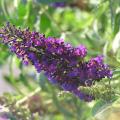
Butterfly bush is a perennial shrub that comes in many colors from white, yellow, pink, rose, to mauve and deep purple. Native to China and is available in many different hybrids, cultivars or varieties. Quite fragrant, attracts butterflies. Butterfly bush needs very good drainage, it will not tolerant wet clay soil. It will grow in poor soil with good drainage. Butterfly bush trives quite well in low water-use areas. Alternate spelling is Buddleja. Not invasive in the Texas Panhandle.Several species are native to parts of Texas and Mexico. B.
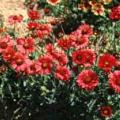
Sometimes referred to as Gaillardia x grandiflora ‘Burgundy’. A cross between G. aristata and G. puchella. I’ve not been able to determine whether these are 2 different varieties, or just name confusion. They must be quite similar, nonetheless. It reseeded once for me, so I'm not sure at all. Medium water for this plant through the heat of summer will prolong blooms, as will afternoon shade. A stunning plant and prolific bloomer for your border.
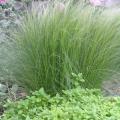
A mid height grass suitable for any low water-use garden, city or country. It does self-seed somewhat, but I hadn’t noticed it to be a problem in a xeric setting (simply remove or transplant them). It's greatest attribute is it's gently flowing nature int he wind. It is native to Texas and the southwest. I saw it growing along the slopes of the Chisos Mountains in Big Bend National Park. It pairs well with yucca, agave, Calylophus and any native shrub.
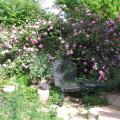
Remarkable old Bourbon rose dating to 1868. Remarkable for fragrance and bright cerise pink flowers, and best of all, thornless canes -- it's people friendly! Not strictly a climber, but a mannerly climber.
Zephirin Drouhin is planted in a low water-use location.
A non-invasive tansy from southern and central Europe for your low water-use bed and border that will reseed somewhat. A short lived perennial. Gray cut-leaf foliage provides an attractive white element in the garden.
Strongly aromatic.
If you find yourself in Palo Duro Canyon at the end of April or beginning of May, the purple haze dotting the cliffsides is feather dalea. Sporadic blooms will open after showers throughout summer, though never as profuse as in springtime. With monthly irrigation in a xeric garden, feather dalea adds color and texture with it's twiggy, but sturdy, appearance. Small purple flowers combined with white plumes carries the haze impression from a distance.
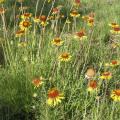
Another tough and pretty wildflower that populates a wide area from the plains of Oklahoma down to the Chihuahua Desert and over to Colorado and Utah. Leaves are lower near the base of the plant from which stems emerge and bloom in late spring to early summer. Yellow rays with a red to brownish center.
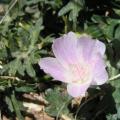
Similar in form to Callirhoe involucrata, Callirhoe alcaeoides 'Logan Calhoun' grows natively from the Midwest to southern plains. While Callirhoe alcaeoides can be pink, to pale pink and pale lilac, 'Logan Calhoun' is pure white. Spreads over an area similar to wine cups, the foliage and flowers are finer. I've found it to be drought tolerant; water monthly to insure continued blooms. Blooms will rest during the heat of the summer and continue following rains or cooler weather.
Fame flower, flame flower, or rock pink, is a Midwestern native succulent. Ideally suited to western rock gardens, short fleshy narrow leaves emerge in late spring, followed by wiry stems where tiny rose/pink flowers open up each afternoon. In fall, the top foliage dies off and the plant heads underground for the winter. Because of it's unusual nature, it can be tucked in anywhere at the front of a border, just don't forget where you've planted it when doing spring cleanup. Reseeds slightly.
Phemeranthus calycinum was formerly known as Talinum calycinum.
Prairie dropseed is smaller than both alkali or giant sacaton, more fitting for the city garden. A warm season bunch grass, prairie dropseed is a most attractive low or medium water-use grass with graceful green foliage. The seed heads emerge in late summer into fall with light pink seeds, that is said to naturalize some, but not invasively. A slow grower. Foliage turns a pleasing golden orange in the fall. Native throughout the Great Plains, including Texas. Tolerates most soil conditions.
Green santolina is an evergreen shrub native to the Mediterranean region. Its grass-green color makes it a welcome addition to any landscape. Medium and low water use, cold hardy, sun and heat tolerant, it prefers poorer soil. Aromatic green leaves that resemble those of the cypress. Yellow button flowers in summer.
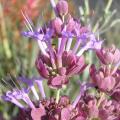
Beautiful xeric sage with aromatic soft gray green leaves, mostly evergreen. Summer to fall blooming with mauve/purple sticky but fragrant flowers. Takes a few years to reach mature height. Requires good drainage and dry soil in the winter. A Plant Select® Plant. Native to California and will grow in the High Desert regions. Cold hardy to Zone 5 and quite heat tolerant.
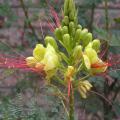
Desert never equates with drab. The flowers on Desert Bird of Paradise are simply stunning! Though classified as a Zone 7 plant, I’ve grown Desert Bird of Paradise for 3-4 years near a south facing wall and have seen several others around Amarillo, without it dying back it to roots. However, if it does, just prune out the dead wood. Eye catching flowers bloom continually from June into fall and attract hummingbirds. Finely divided green leaves. It is said to survive on 8” of rainfall, but monthly soakings enhance it. C. mexicana, Mexican Bird of Paradise and C.
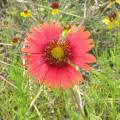
Our showiest native wildflower; an annual. Little care required. Grows along roadsides and in natural areas throughout our region. Gaillardias are popular these days, with many new introductions all the time. G. pulchella is a good choice for seeding in prairie areas with other native grasses and wildflowers.
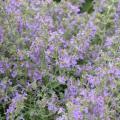
This is not one of the invasive catmints, but it will reseed some and is not as attractive to cats as most catmints. A low growing, sprawling, drought tolerant perennial that projects a hazy blue appearance with its light lavender blue flowers and grayish green foliage. It is aromatic, not necessarily fragrant. A fast spreader and prolific bloomer even in it's first year, it will begin to bloom after six weeks.
Rudbeckia is advertised as heat and drought tolerant, but I have not found it so. I’ve found it to require at least weekly watering during the heat of the summer. A shortlived, southern native perennial, it likes the humidity and rain from southern climes. These very large and stunning composites may be worth your effort, just place within the correct hydrozone.
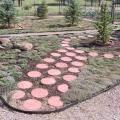
Thyme is known more for its use as an herb, but also makes an attractive and aromatic groundcover. Sometimes referred to as Thymus pseudolanuginosus, Thymus lanuginosus is a low water-use thyme for the hot dry areas that rarely flowers.