High Plains Gardening
The gardening website of the Texas High Plains Region




Able to withstand exposure to roughly 50% sunlight and 50% shade.
Another American native vine, evergreen in more southern climates than ours, but cold hardy here. Fragrant and attractive coral flowers in spring and early summer. Attracts birds, butterflies and hummingbirds. Pleasant glossy green leaves. Not invasive. Medium water-use.
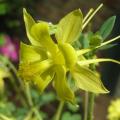
Delicate and fragile in appearance, columbines are some of the most durable, versatile plants in the West. Aquilegia chrysantha is the Texas native columbine, happy in both sun or shade, moist areas or dry. Aquilegia chrysantha is native to the Chihuahuan and Sonoran Desert canyons from west Texas, southern New Mexico, southern Utah, and Arizona south into Sonora, Coahuila, and Nuevo Leon along with a disconnected population in southern Colorado.
Herbaceous perennial. Fragrant hummingbird plant belonging to the mint family (Lamiaceae). Limited reseeding. Does better in afternoon shade. Locate in a transition area between medium and low water use. Leave plant and flower stalks standing in the fall, the plant does better trimmed back at the beginning of March.
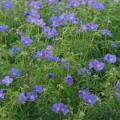
It's hard to pass up Johnson's blue geranium with the deep blue flower and interesting foliage. A hybrid cultivar, the most blue hardy geranium with delicate, finely cut leaves. Plant in your woodland border, medium water use. For a long time this was the most well know hardy geranium, or cranesbill, as this genus is commonly known.
When the name geranium is spoken most of the time, people are referring to the genus, Pelargonium, the red flowering perennial that is used extensively throughout the world. the common Pelargonium is only cold hardy to 28°.
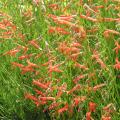
A long-lived evergreen penstemon for the average bed or border. Small orange red tubular flowers attract hummingbirds, as do most red tubular flowers. Low growing and longer flowering than most, especially the more mature the specimen.
After several years, the pine needle like foliage can resemble a miniature bonsai. Pineleaf penstemon is also a must-have for the low water-use bed or border or rock garden because of its evergreen foliage and longer blooming nature. In late summer, snip off the dried, spent flower heads; some re-blooming may occur.
There are numerous interesting yuccas to choose from besides the Yucca glauca or Y. angustifolia seen throughout our area. Y. filamentosa ‘Color Guard’ has some of the most striking variegation and will even flower in part shade, cold hardy to Zone 5. Other Y. filamentosa varieties to consider growing in our area are ‘Bright Edge’ and ‘Golden Sword’.
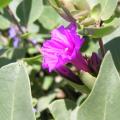
Rounded mounds of green leaves on multi-forked stems put forth multitudes of fragrant purple/magenta flowers from summer into autumn. Flowers open in late afternoon (perhaps around four o'clock) and close in early morning. Cold hardy and heat and drought tolerant, after freezing in the fall, the top growth breaks away. Desert four o'clock emerges in the spring from a large root. Will not transplant well once established. Southwest native perennial is usually found in somewhat shaded areas.
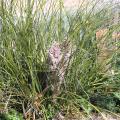
Texas beargrass is a grass-like perennial evergreen plant native in rocky and limestone soils from central Texas to the upper Rio Grande Plains and west to the Trans-Pecos and into S.E. Arizona. Not a true grass, Texas sacahuista is a member of the lily (Liliaceae ) family. It flowers in Amarillo in early April. A short flowering stem barely rises above the many thin leaves. The flowers appear rose or reddish on the outside before opening, are numerous, white to cream colored forming dense vertical clusters.