High Plains Gardening
The gardening website of the Texas High Plains Region




A perennial plant is a plant that requires one or more years to reproduce and usually continues living, but not indefinitely. Whether a plant is cold hardy or not is not connected to being an annual, perennial or biennial.
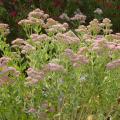
The Crassulaceae family of plants fascinates me, and the sedums are one of its larger genera. I first saw ‘Frosty Morn” featured on a gardening program from Iowa, so I wondered whether it’d be drought tolerant. Shortly afterwards, I found it at our local nursery and planted in my xeristrip. It has never faltered. The only disfiguring occurrence is a little nipping by grasshoppers during early summer, which has never seemed to harm it, or other large leafed sedums.
Wagons Ho! Rugged, ragged and windblown -- a true picture of the western and southwestern landscape. If you have a skeleton of a steer's head, now is the time to use it, along with that wagon wheel. Sometimes referred to as the western sage.
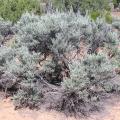
Big sagebrush is a coarse, many-branched, aromatic, pale-grey shrub with yellow flowers and light silvery-grey foliage. It flowers in late summer to early fall. The leaves are wedge-shaped with three lobes.
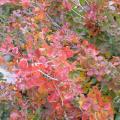
Sumacs are known for brillian fall foliage. Ground cover woody shrub 24-30" tall with dark shiny green leaves that turn a thrilling orange-red in the fall. Small yellow flowers at springtime.
Agaves are striking and architectural Southwest native plants and are included in a group of plants I term Southwest evergreens. They are unusual in that at maturity, they only flower once, and then die. for this reason, some classify them as multiannual, rather than perennial. However, as they common name suggests, it takes many years before they flower. Leaves of the Agave are arranged in a spiral beginning from a near invisible stem, forming a rosette.Agaves vary in size from 4-6 inches to larger than man-size.
Maypop, or passion vine, is a perennial vine native to eastern and southern areas of the U.S. In the South, maypop grows into a woody vine, but in northern areas like the Texas Panhandle, it will die back to the ground. Lobed, dark green leaves, beautiful, unique flowers emerge in the summer to fall, producing edible fruit. Maypop will sucker, especially when ample watering is present. Passion vine, the most cold hardy of the genus, should be cold hardy to Zone 6.
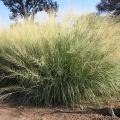
Giant sacaton is one of the largest bunch grasses native to the Southwest, like alkali sacaton on steroids. Seems to thrive in poor soils with no supplemental irrigation. It will grow even bigger with added moisture. Thick textured grass blades, it will rival pampas grass for size and beauty, although it plumes are near as showy, giant sacaton has a flowing fountain appearance. A warm season grass, it is cold hardy and thrives in sun and heat.
Lavender cotton, or gray santolina is a low mounding woody subshrub that should live on the lean side. Not that it won't overgrow if fed. It will maintain its compact shape in poorer soils without amending or fertilizing. Small silver gray leaves cover the shrub. Tiny yellow button flowers appear in summer. Evergreen, the santolinas are native to the Mediterranean area. Aromatic and edible, it's leaves were used as a flavoring in broths, sauces and grain dishes. Low water-use.
Mat daisy is a low growing spring blooming plant. Drought tolerant. Not exactly a groundcover, as the top growth disappears during summer and reemerges as a green basal rosette in fall, getting ready to bloom again in the spring. Blooms late March to May with small white daisy-like flowers that have pink undersides. Forms a compact ground-hugging mat. Will self seed some, but never invasively.
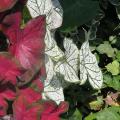
Caladium corms are tropical plants grown for their summer foliage, however they do send up an arum type flower (a member of the Araceae family). Foliage comes in many different variegation patterns in red, pink and white. There are a over a thousand cultivars, most from the Caladium bicolor species. Plant bulbs after May 1st, only about 3 inch deep. Caladiums like it hot and moist. Complete shade works OK, or morning sun only.There are a few sun tolerant cultivars available. For larger leaves.
I am unable to correctly identify the species of ‘Sapphire Blue’ sea holly. I have found references with it shown as a variety or hybrid cultivar of E. alpinum, E. maritimum, E. amethystinum and E. x planum. If you’re looking to order this plant, anyone of the species will produce a plant that looks similar to the picture. This sea holly is named more for its steel blue foliage, than for the color of the flower. Sea hollies make an excellent cut and dried flower and make a stunning architectural display in the garden.
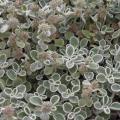
The only draw back to this pretty, silver-edged groundcover is its flowers! If only it didn’t, it would be a perfect no maintenance, no water groundcover for hot, sunny locations. You can see the tiny ball shaped flower heads in the picture, which look rather indistinct. However, after flowering, they turn an ugly shade of brown that mar the beautiful leaves unless you shear them off. Though a creeping groundcover, silver-edged horehound is not invasive like the common horehound, M. vulgare.
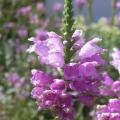
Another old garden perennial that’s still good for our Panhandle cottage gardens, Physotegia virginiana is native to eastern and southeastern US. A terrific addition to the late summer and fall garden. Comes in three pleasing colors of light pink, purplish pink and a real pretty white. The white variety "Miss Manners' and 'Summer Snow' are both better mannered, not spreading quite as vigorously. It's native habitat is in moist, rich soils, but keeping it on the lean side makes it more "obedient".
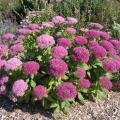
Sedum, ‘Autumn Joy’ is one of those foolproof additions to your autumn garden, so aptly named; for the joy it brings to the autumn garden. Easily propagated by stem cuttings or root division. As with most sedums, afternoon shade helps. Grasshoppers have nibbled at its leaves in early summer without stunting the plant’s flowering ability.
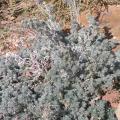
Lower growing Southwestern native shrub, both cold and heat tolerant. Finely cut greenish silver leaves. Flower stalks with insignificant flowers. Grows best in soils with good drainage. Will grow in heavy clay soil if grown among grasses.
Rarely does a shrub feature as much versatility as the blue mist spirea. It will grow and flower in sun or shade, low water-use or high. This Caryopteris, a hybrid itself, normally blooms in a pleasant light blue, but other selections have deeper blues hues. Summer blooming into fall. And as unlikely at it seems for hybrid to set viable seed, blue mist spirea reproduces itself pleasantly, never invasively. Indeed, any little volunteers are welcome.
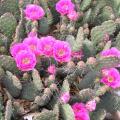
Not all succulents are cacti, nearly all cacti are succulents (a few exceptions). Nearly all cactus species are native to the Americas, providing a prickly evergreen presence. There are many cactus that are cold hardy for the Texas Panhandle. There might be one for your garden.
Fame flower, flame flower, or rock pink, is a Midwestern native succulent. Ideally suited to western rock gardens, short fleshy narrow leaves emerge in late spring, followed by wiry stems where tiny rose/pink flowers open up each afternoon. In fall, the top foliage dies off and the plant heads underground for the winter. Because of it's unusual nature, it can be tucked in anywhere at the front of a border, just don't forget where you've planted it when doing spring cleanup. Reseeds slightly.
Phemeranthus calycinum was formerly known as Talinum calycinum.
Prairie dropseed is smaller than both alkali or giant sacaton, more fitting for the city garden. A warm season bunch grass, prairie dropseed is a most attractive low or medium water-use grass with graceful green foliage. The seed heads emerge in late summer into fall with light pink seeds, that is said to naturalize some, but not invasively. A slow grower. Foliage turns a pleasing golden orange in the fall. Native throughout the Great Plains, including Texas. Tolerates most soil conditions.
Green santolina is an evergreen shrub native to the Mediterranean region. Its grass-green color makes it a welcome addition to any landscape. Medium and low water use, cold hardy, sun and heat tolerant, it prefers poorer soil. Aromatic green leaves that resemble those of the cypress. Yellow button flowers in summer.
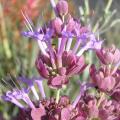
Beautiful xeric sage with aromatic soft gray green leaves, mostly evergreen. Summer to fall blooming with mauve/purple sticky but fragrant flowers. Takes a few years to reach mature height. Requires good drainage and dry soil in the winter. A Plant Select® Plant. Native to California and will grow in the High Desert regions. Cold hardy to Zone 5 and quite heat tolerant.
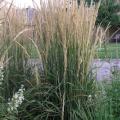
Karl Foerster feather reed grass is a cool season bunch grass one of the best ornamental grasses for a medium or high water-use area. In a low water-use area, it will take longer to reach mature height and width (the more water it gets, the bigger it'll get). Karl Foerster feather reed grass suffers in the xeric bed during the hotter, drier drought years and may die out.
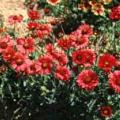
Sometimes referred to as Gaillardia x grandiflora ‘Burgundy’. A cross between G. aristata and G. puchella. I’ve not been able to determine whether these are 2 different varieties, or just name confusion. They must be quite similar, nonetheless. It reseeded once for me, so I'm not sure at all. Medium water for this plant through the heat of summer will prolong blooms, as will afternoon shade. A stunning plant and prolific bloomer for your border.
Native wildflower that likes it lean and mean. Over watering and well amended soil will usually cause Blackfoot daisy to die a premature death, even for a short lived perennial, such as it is. It would be an ideal border plant, similar to alyssum, if not for its tendency to move about where it will (that is, die where you plant it and seed somewhere else). Still, it’s worth a try. Our Panhandle xeric gardens should never be without Blackfoot Daisy. In fact, once you plant Blackfoot daisy and let it seed, you should never be without it (and that’s a good thing).
This variety of cinquefoil has grown in my xeristrip for six years and flowers happily from late spring into fall, with moderate flowering during the heat of the summer. Will put on a new show of flowers after summer rain. It maintains a compact shape without pruning or any maintenance.
There are many other varieties of this wonderful North American native that grows throughout the Rocky Mountains. Other varieties require moderate watering. This variety was purchased from High Country Gardens; I have not seen this truly drought tolerant variety again.
Native to a large part of North America, golden rod is a pleasant addition to your native garden, and contrary to popular myth, does not cause allergies; the pollen is too heavy to be wind born. But choose a variety of Solidago that does not have invasive rhizamatous roots for lower maintenance.
Attracts bees and butterflies.