High Plains Gardening
The gardening website of the Texas High Plains Region




Caliche is defined as a crust or a succession of crusts of calcium carbonate that form within or on top of stony soil in arid and semi-arid regions and is often combined with clay. Caliche is lacking in organic matter. Its crusting tendencies often prohibit drainage.
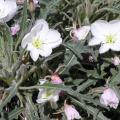
Drought tolerant perennial with white cup shaped blooms usually found growing in poor soils. I planted it in heavily amended soil, and I think it was too rich for it. It was eaten up during the heat of the summer by flea beetles. I thought the too rich soil was the cause; however, Judith Phillips in Plants For Natural Gardens, wrote about this same occurrence in native soils. Phillips hypothesized this may be a way for tufted evening primrose to escape summer’s heat. However, my plant died, rather than just going to ground.
If you find yourself in Palo Duro Canyon at the end of April or beginning of May, the purple haze dotting the cliffsides is feather dalea. Sporadic blooms will open after showers throughout summer, though never as profuse as in springtime. With monthly irrigation in a xeric garden, feather dalea adds color and texture with it's twiggy, but sturdy, appearance. Small purple flowers combined with white plumes carries the haze impression from a distance.
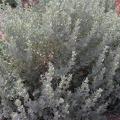
Shadscale lives in alkaline caliche soil in most of its native range throughout the Southwest and has a high tolerance of saline or sodic soils. Given improved soil conditions, it will grow larger. Do not improve the soil to insure it keeps its neat, compact shape. Shadscale blooms yellow flowers in early summer which mature into seed heads. Its silver-gray leaves are semi-evergreen.
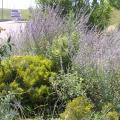
Purple or desert sage prefers leaner, quick draining soils. It is said to grow 2-3 feet tall and deeply branched with silver gray foliage and a profusion of violet bluish flowers atop spikes in late spring and summer. Low water-use, but does better with once a month irrigation. One of the finest flowers of the desert, it is the sage of Riders of the Purple Sage, by Zane Grey. Grows throughout the Great Basin Desert.
Turpentine shrub is an evergreen shrub native to the southern parts of the Southwest, and only marginally cold hardy on the Caprock. It will survive when in a sheltered location and soil with excellent drainage, along rocky cliffs, outcrops and arroyos. Avoid compact clay soil, or amend clay soil very well for drainage with inorganic amendments. Yellow autumn flowers.
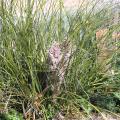
Texas beargrass is a grass-like perennial evergreen plant native in rocky and limestone soils from central Texas to the upper Rio Grande Plains and west to the Trans-Pecos and into S.E. Arizona. Not a true grass, Texas sacahuista is a member of the lily (Liliaceae ) family. It flowers in Amarillo in early April. A short flowering stem barely rises above the many thin leaves. The flowers appear rose or reddish on the outside before opening, are numerous, white to cream colored forming dense vertical clusters.
Oenothera macrocarpa, and O. missouriensis have been used interchangeably. Native over a wide range including the plains and wooded areas, carries the common name, Missouri evening primrose, bigfruit sundrops and Ozark Sundrops.
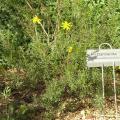
Dark green, semi-evergreen aromatic leaves are the feature most prized, along with the tiny yellow daisy-like flowers that bloom spring to fall. Damianita prefers full sun and lean soil and does well in heat and temperatures to zero degrees. Daminaita will lose its leaves in cold winters.
Texas betony is a workhorse of the garden once established, putting on a plethora of scarlet blooms midsummer on. A member of the mint family with square stems, the foliage is fragrant, but the plant is not invasive as classic mints tend to be. Hummingbirds love Texas betony. Though native to the Southwest, it is found in moist crevices and steep, stony places in the mountains in moist, well-drained sand, loam, and clay. Texas betony is said to be cold hardy to -20°, however, I have not found it reliable in returning each winter. Yet, it is worth replanting.
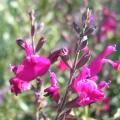
Raspberry hybrid bush sage is very similar in appearance to Salvia greggii, blooming April through November. It's two-lipped flowers with a pleasant deep raspberry color, and the mahogany calyces contrast nicely. 'Raspberry Delight' is a hybrid cross between Salvia greggii 'Furman's Red' and and a high altitude collection of Salvia microphylla from central Arizona. Woody and brittle branches with small oval shaped leaves that hang on to the plant sometimes through the winter, as they do on S. greggii.
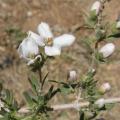
Cliff fendlerbush is another Texas and Southwest native shrub too little used in the xeric landscape. Springtime lifts the cliff fendlerbush above the ordinary into prominence in the landscape. It is said the ravines and arroyos look dotted with snow from a distance, so profuse are the fragrant, creamy white, sometimes with a pink tinge, four petaled flowers in May and June. It's natural element is rocky arroyos (rupicola=rock dweller), cliff ledges and limestone soils with good drainage that average 12-18 inches of moisture with hot sunny days.
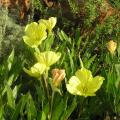
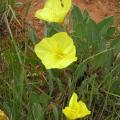
Gorgeous! Luscious goblet shaped lemon yellow flowers on this native wildflower that also develops elongated seed capsules. The lighter, silvery sheen of the leaves distinguishes the O. macrocarpa var. incana subspecies, and is also an evening to morning bloomer.
I prefer dwarf chamisa to the full size species. Dwarf Chamisa fits better into home xeric areas and has green leaves, rather than gray or silvery. It's silvery stems combine well with its green foliage and yellow gold flowers. Although given the species and variety name "nauseosus" it has a pleasant fragrance. Dwarf chamisa blooms profusely in late summer and will readily re-seed.
Agaves are striking and architectural Southwest native plants and are included in a group of plants I term Southwest evergreens. They are unusual in that at maturity, they only flower once, and then die. for this reason, some classify them as multiannual, rather than perennial. However, as they common name suggests, it takes many years before they flower. Leaves of the Agave are arranged in a spiral beginning from a near invisible stem, forming a rosette.Agaves vary in size from 4-6 inches to larger than man-size.
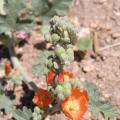
Gooseberryleaf globemallow is very close in appearance to scarlet globemallow, Sphaeralcea coccinea, but much taller, up over 2 feet. The leaves are silver green and hairy, resembling the leaves of the current shrubs in shape, so named from the family name of currents and gooseberries, Grossulariaceae. Flowers are orange in color and bloom from May and June, sometimes later in the summer. Native to hot, dry areas semi-arid regions throughout the Southwest and the Great Basin Desert. Prefers good to sharp drainage.
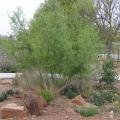
New Mexican privet can be viewed either as a tall shrub or smaller tree. New Mexican privet will flower (tiny yellow) before leafing out with small oval glossy green leaves to be followed with black berries in the fall. Heat and drought tolerant will live in most soils and water-use areas. Attractive taller plant for the home landscape, similar to the yaupon holly in form.