High Plains Gardening
The gardening website of the Texas High Plains Region




Soil that contains a high percentage of fine particles smaller than .002mm in diameter and colloidal substance and becomes sticky when wet. Clay soils can be mixtures of clay, sand and silt, with clay having the greatest percentage.
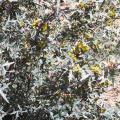
Native evergreen shrub that makes an excellent hedge plant and wind break. Its blue-green prickly leaves keep the unwanted out (to a point). Please allow room for its spread.
A habitat plant for shelter and as a food source of food for birds and other wildlife that is an attractive addition to the home landscape, where an evergreen shrub is called for in a sunny spot. Sun yellow flowers in March. Cold hardy to -20°, algerita can be found growing from 4000 to 7000 ft. in elevation in Texas, the southwest and Mexico.
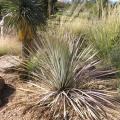
Dasylirion is one of the plants I call a southwest evergreen. Different in appearance from traditional evergreen shrubs, it fulfills the same purpose in native and xeric landscapes. Symmetrical rosette of narrow leaf blades or leaves emanating from the center of the rosette. Barbs lining the margins of the thick pale green leaves give Dasylirion another common name, sawtooth yucca. As Sotol ages, a trunk may form under the rosette and even multiple heads may develop. At maturity, an 8-10 foot tall flower spike ascends from the center where thousands of small creamy white flowers open.
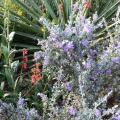
Big Bend silverleaf is the most cold hardy of the Leucophyllums and has wintered over in Amarillo, Zone 7, for 5 years so far. Possibly cold hardy to Zone 6. It is hard to beat a more attractive summer blooming shrub for small xeric spaces. After summer rainfalls, Big Bend silverleaf, native to the Big Bend National Park area, becomes covered in silver blue flowers that twinkle like jewels among its silvery gray leaves. Hard to find, it's worth searching for.
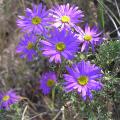
Tansy aster is an annual native to the Southwest and throughout the Plains even into Canada. Fernlike, or tansy-like (tannacetifolia) light green foliage with beautiful aster-like lavender flowers with yellow disks about 1 1/2 to 2 inches across. Blooms from late spring through fall. A once a month watering will keep the blooms coming throughout the summer. It will keep its compact shape in lean, poor soil but will become much larger in well amended soil. Minimal amending is recommended. Tansy aster is another example of our natives plants giving so much, asking so little in return.
Prairie dropseed is smaller than both alkali or giant sacaton, more fitting for the city garden. A warm season bunch grass, prairie dropseed is a most attractive low or medium water-use grass with graceful green foliage. The seed heads emerge in late summer into fall with light pink seeds, that is said to naturalize some, but not invasively. A slow grower. Foliage turns a pleasing golden orange in the fall. Native throughout the Great Plains, including Texas. Tolerates most soil conditions.
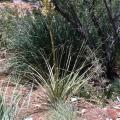
Bear grass is similar in appearance to yucca and clumping grass, but is neither. Usually found growing in high desert areas, along cliffs and rocky slopes. Thin succulent grasslike yellow-green leaves emerge from a trunkless center, are pointed and sharp edged. A plume-like inflorescence with many tiny cream colored flowers emerges early summer. Cold hardy, drought and heat tolerant.