High Plains Gardening
The gardening website of the Texas High Plains Region




Plants that are native to the American Southwest that exist without supplemental irrigation once established.
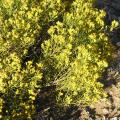
Broom snakeweed is a small mounded subshrub with yellow greenish thread-like leaves, native throughout the Southwest and western half of the North American continent. In the fall, it becomes covered in small golden yellow flowers. Bees and nectar butterflies are attracted to it in numbers. Usually grows to only a foot tall.
Lindheimers muhly grass is native to the Edwards Plateau of Texas. It is cold hardy and heat tolerant, a tall, warm season bunch grass. It forms a good size ornamental specimen with upright blue green or blue gray blades and tall showy, almost spike like inflorescences in late summer. Not as large as pampas grass, it is a better native alternative. There are two muhly grasses native to the Southwest, Muhlenbergia asperifolia, scratchgrass, and M.
Lavender cotton, or gray santolina is a low mounding woody subshrub that should live on the lean side. Not that it won't overgrow if fed. It will maintain its compact shape in poorer soils without amending or fertilizing. Small silver gray leaves cover the shrub. Tiny yellow button flowers appear in summer. Evergreen, the santolinas are native to the Mediterranean area. Aromatic and edible, it's leaves were used as a flavoring in broths, sauces and grain dishes. Low water-use.
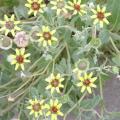
Native to the Texas Panhandle, the south and into northern Mexico. Strong chocolate scent fills the morning air. Xeric herbaceous perennial with a deep taproot. Flower closes up during the heat of the day, staying open during more moderate days. Good choice for naturalizing. Best to keep soil on the lean side, will grow leggy in amended soil. Reseeding profusely. Cut back flower to base at end of June if it becomes too leggy. Within weeks, it'll grow back and begin flowering again.
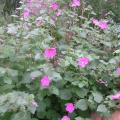
Although there is question in my mind whether pavonia is a native in Texas, it’s been naturalized for a long time and is found growing in the Edwards Plateau and south Texas. Pavonia has been cold hardy for me for at least 5 – 6 years. Readily reseeds to the point of being a nuisance, but this is a minor annoyance.
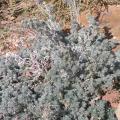
Lower growing Southwestern native shrub, both cold and heat tolerant. Finely cut greenish silver leaves. Flower stalks with insignificant flowers. Grows best in soils with good drainage. Will grow in heavy clay soil if grown among grasses.
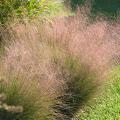
Warm season native clumping ornamental grass that is well suited to the transition zone between turf and flower bed. Medium to blueish green thin grass blades form a low to medium size clump, medium water-use zone. In late September, it sends plumes upward that give the appearance of a deep pink haze or mist. There are several new selections of Gulf Coast muhly, thankfully, to choose from. Be sure to pay attention to the cold hardiness for your area and you won't be disappointed.
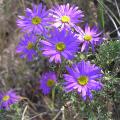
Tansy aster is an annual native to the Southwest and throughout the Plains even into Canada. Fernlike, or tansy-like (tannacetifolia) light green foliage with beautiful aster-like lavender flowers with yellow disks about 1 1/2 to 2 inches across. Blooms from late spring through fall. A once a month watering will keep the blooms coming throughout the summer. It will keep its compact shape in lean, poor soil but will become much larger in well amended soil. Minimal amending is recommended. Tansy aster is another example of our natives plants giving so much, asking so little in return.
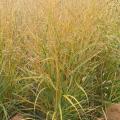
Switchgrass is one of the best native ornamental grasses of our tall prairies. Switchgrass forms upright bunches of wide 1/2 inch green blades, with open pale purple inflorescence arising another 2 feet in late summer to fall. Switchgrass will thrive with every other week supplemental irrigation. There are many varieties of switchgrass, 'Prairie Sky' is the most drought tolerant (low, xeric) with blue blades. Other fine selections are 'Heavy Metal' with metallic lavender blue foliage turning reddish towards fall, and 'Shenandoah' with leaf blades tipped in red.
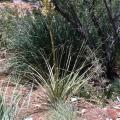
Bear grass is similar in appearance to yucca and clumping grass, but is neither. Usually found growing in high desert areas, along cliffs and rocky slopes. Thin succulent grasslike yellow-green leaves emerge from a trunkless center, are pointed and sharp edged. A plume-like inflorescence with many tiny cream colored flowers emerges early summer. Cold hardy, drought and heat tolerant.