High Plains Gardening
The gardening website of the Texas High Plains Region




Plants are known to be cold hardy to at least -10°F.
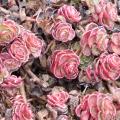
There are many different sedum species and varieties of this delightful spreading groundcover. I took this picture on a garden tour in Angel Fire New Mexico, and have not been able to identify it yet. It is easy to see from the picture how it got its common name, stonecrop. Sedum groundcovers spread nicely in a low to medium water use area of gritty, well drained soil, and will do just fine in afternoon shade.
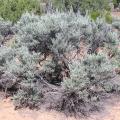
Wagons Ho! Rugged, ragged and windblown -- a true picture of the western and southwestern landscape. If you have a skeleton of a steer's head, now is the time to use it, along with that wagon wheel. Sometimes referred to as the western sage.
Big sagebrush is a coarse, many-branched, aromatic, pale-grey shrub with yellow flowers and light silvery-grey foliage. It flowers in late summer to early fall. The leaves are wedge-shaped with three lobes.
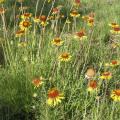
Another tough and pretty wildflower that populates a wide area from the plains of Oklahoma down to the Chihuahua Desert and over to Colorado and Utah. Leaves are lower near the base of the plant from which stems emerge and bloom in late spring to early summer. Yellow rays with a red to brownish center.
Native to the plains, Coreopsis tinctoria, has naturalized throughout most of the U.S., especially in disturbed soil. Prefers moist sandy soil. An annual, it may last more than one year. Very showy flower with yellow outer rays, with a maroon blotch towards the center ray. Sow seeds in early spring. Heat tolerant, once a month watering is recommended for well drained soil.
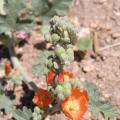
Gooseberryleaf globemallow is very close in appearance to scarlet globemallow, Sphaeralcea coccinea, but much taller, up over 2 feet. The leaves are silver green and hairy, resembling the leaves of the current shrubs in shape, so named from the family name of currents and gooseberries, Grossulariaceae. Flowers are orange in color and bloom from May and June, sometimes later in the summer. Native to hot, dry areas semi-arid regions throughout the Southwest and the Great Basin Desert. Prefers good to sharp drainage.
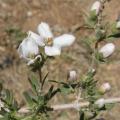
Cliff fendlerbush is another Texas and Southwest native shrub too little used in the xeric landscape. Springtime lifts the cliff fendlerbush above the ordinary into prominence in the landscape. It is said the ravines and arroyos look dotted with snow from a distance, so profuse are the fragrant, creamy white, sometimes with a pink tinge, four petaled flowers in May and June. It's natural element is rocky arroyos (rupicola=rock dweller), cliff ledges and limestone soils with good drainage that average 12-18 inches of moisture with hot sunny days.
Bush morning glory is a non-vining herbaceous perennial with a deep taproot, allowing it to be drought tolerant, but difficult to transplant. Arching branches with narrow upright green leaves emerge from the taproot. Summer blooming with 3 inch pink to purple funnel shaped flowers that open in the morning and close in the afternoon. Bush morning glory typically inhabits sandy and sandy loan plains, meadows, prairies and roadsides.
Native to the Texas Panhandle, the south and into northern Mexico. Strong chocolate scent fills the morning air. Xeric herbaceous perennial with a deep taproot. Flower closes up during the heat of the day, staying open during more moderate days. Good choice for naturalizing. Best to keep soil on the lean side, will grow leggy in amended soil. Reseeding profusely. Cut back flower to base at end of June if it becomes too leggy. Within weeks, it'll grow back and begin flowering again.
I am unable to correctly identify the species of ‘Sapphire Blue’ sea holly. I have found references with it shown as a variety or hybrid cultivar of E. alpinum, E. maritimum, E. amethystinum and E. x planum. If you’re looking to order this plant, anyone of the species will produce a plant that looks similar to the picture. This sea holly is named more for its steel blue foliage, than for the color of the flower. Sea hollies make an excellent cut and dried flower and make a stunning architectural display in the garden.
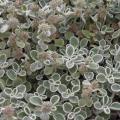
The only draw back to this pretty, silver-edged groundcover is its flowers! If only it didn’t, it would be a perfect no maintenance, no water groundcover for hot, sunny locations. You can see the tiny ball shaped flower heads in the picture, which look rather indistinct. However, after flowering, they turn an ugly shade of brown that mar the beautiful leaves unless you shear them off. Though a creeping groundcover, silver-edged horehound is not invasive like the common horehound, M. vulgare.
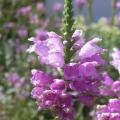
Another old garden perennial that’s still good for our Panhandle cottage gardens, Physotegia virginiana is native to eastern and southeastern US. A terrific addition to the late summer and fall garden. Comes in three pleasing colors of light pink, purplish pink and a real pretty white. The white variety "Miss Manners' and 'Summer Snow' are both better mannered, not spreading quite as vigorously. It's native habitat is in moist, rich soils, but keeping it on the lean side makes it more "obedient".
The Crassulaceae family of plants fascinates me, and the sedums are one of its larger genera. I first saw ‘Frosty Morn” featured on a gardening program from Iowa, so I wondered whether it’d be drought tolerant. Shortly afterwards, I found it at our local nursery and planted in my xeristrip. It has never faltered. The only disfiguring occurrence is a little nipping by grasshoppers during early summer, which has never seemed to harm it, or other large leafed sedums.
Verbascums make a presence in the wildflower or cottage garden and mixed border, whether it be this common mullein, or another species with showier flowers. Verbascums can be either biennial or perennial, but will make enough seeds you’ll never be without. Some are drought tolerant and thrive in poor, but well drained soil, others may need medium water use and a richer soil.
Texas red yucca is technically not a yucca, but has many of the same qualities as yuccas. Thick, succulent dark olive green leaves grow out of the base, as it is stemless. The coral red flowers appear at the top of a long raceme, often 4-6 feet tall. 'Yellow' and 'Red' blooming yuccas are also available. Although it's natural range is north eastern Mexico and West Texas, it is cold hardy throughout much of the Southwest. Allow for sharp drainage in moister climates to prevent root rot.
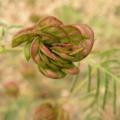
Illinois bundleflower should be grown for its unusual characteristics of seedpods and leaves, if nothing else. A member of the legume or bean family, the seed pods turn dark brown, leathery and twisted in appearance and rattle in the wind in late fall. The compound, alternate, pinnate leaves fold when touched or when exposed to strong sunlight. Small white flowers in summer. Attracts butterflies, birds love its seeds. The plant can grow to be quite large if in high water-use areas.
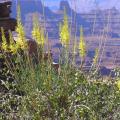
Elegant and stately desert perennial. Soft light blue green leaves. Stalks can tower above desert shrubs to 5-6 feet, but usually 2-4 feet, with racemes of yellow flowers similar to cleome or spider plant flowers in springtime. Requires excellent drainage and lean soils. Thrives on selenium rich soils. Native to canyonlands in SW U.S.
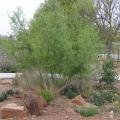
New Mexican privet can be viewed either as a tall shrub or smaller tree. New Mexican privet will flower (tiny yellow) before leafing out with small oval glossy green leaves to be followed with black berries in the fall. Heat and drought tolerant will live in most soils and water-use areas. Attractive taller plant for the home landscape, similar to the yaupon holly in form.
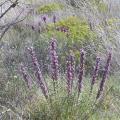
Gayfeather is one of the High Plains jewels of autumn, sending up grasslike leaves or stalks that bloom gloriously in September and October to fuzzy purple spikes. At maturity, one plant can grow a dozen or more, size and number depending on rainfall amounts. Drier years, the stalks are few and short, but with monthly or twice a month watering, the plant displays much more vitality. The purple flowers contrast nicely with the many yellow flowers that bloom on the plains. Liatris punctata is the most drought tolerant of the genus.
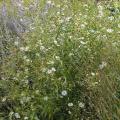
Terrific taller plant for the late summer garden. Native from eastern U.S. that grows well here too in a medium water-use area. Talls stems with numerous yellow centered, small aster-like white flowers that look similar in appearance to Michaelmas daisies. Propagation by root division in spring or by seeds. Does reseed some. Other varieties are 'Snowbank' only to about 4-5' but with larger flowers, and 'Pink Beauty' with pink flowers.
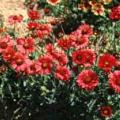
Sometimes referred to as Gaillardia x grandiflora ‘Burgundy’. A cross between G. aristata and G. puchella. I’ve not been able to determine whether these are 2 different varieties, or just name confusion. They must be quite similar, nonetheless. It reseeded once for me, so I'm not sure at all. Medium water for this plant through the heat of summer will prolong blooms, as will afternoon shade. A stunning plant and prolific bloomer for your border.
Native wildflower that likes it lean and mean. Over watering and well amended soil will usually cause Blackfoot daisy to die a premature death, even for a short lived perennial, such as it is. It would be an ideal border plant, similar to alyssum, if not for its tendency to move about where it will (that is, die where you plant it and seed somewhere else). Still, it’s worth a try. Our Panhandle xeric gardens should never be without Blackfoot Daisy. In fact, once you plant Blackfoot daisy and let it seed, you should never be without it (and that’s a good thing).
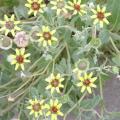
This variety of cinquefoil has grown in my xeristrip for six years and flowers happily from late spring into fall, with moderate flowering during the heat of the summer. Will put on a new show of flowers after summer rain. It maintains a compact shape without pruning or any maintenance.
There are many other varieties of this wonderful North American native that grows throughout the Rocky Mountains. Other varieties require moderate watering. This variety was purchased from High Country Gardens; I have not seen this truly drought tolerant variety again.
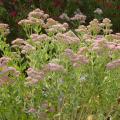
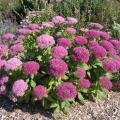
Sedum, ‘Autumn Joy’ is one of those foolproof additions to your autumn garden, so aptly named; for the joy it brings to the autumn garden. Easily propagated by stem cuttings or root division. As with most sedums, afternoon shade helps. Grasshoppers have nibbled at its leaves in early summer without stunting the plant’s flowering ability.
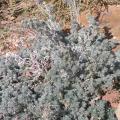
Lower growing Southwestern native shrub, both cold and heat tolerant. Finely cut greenish silver leaves. Flower stalks with insignificant flowers. Grows best in soils with good drainage. Will grow in heavy clay soil if grown among grasses.
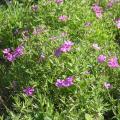
Santa Fe phlox is rarely available even at native plant nurseries, but when it is, don't pass it up. Sun loving and drought tolerant, the Santa Fe phlox blooms late spring throughout the summer with once a month watering. Five petaled, small pink flowers about an inch across with a small white eye can cover the plant. Native to canyons, mesas, and rocky desert slopes from West Texas to southeastern Arizona and into northern Mexico. Seeds of the phlox pop out when they are mature, making seed collection and propagation difficult.